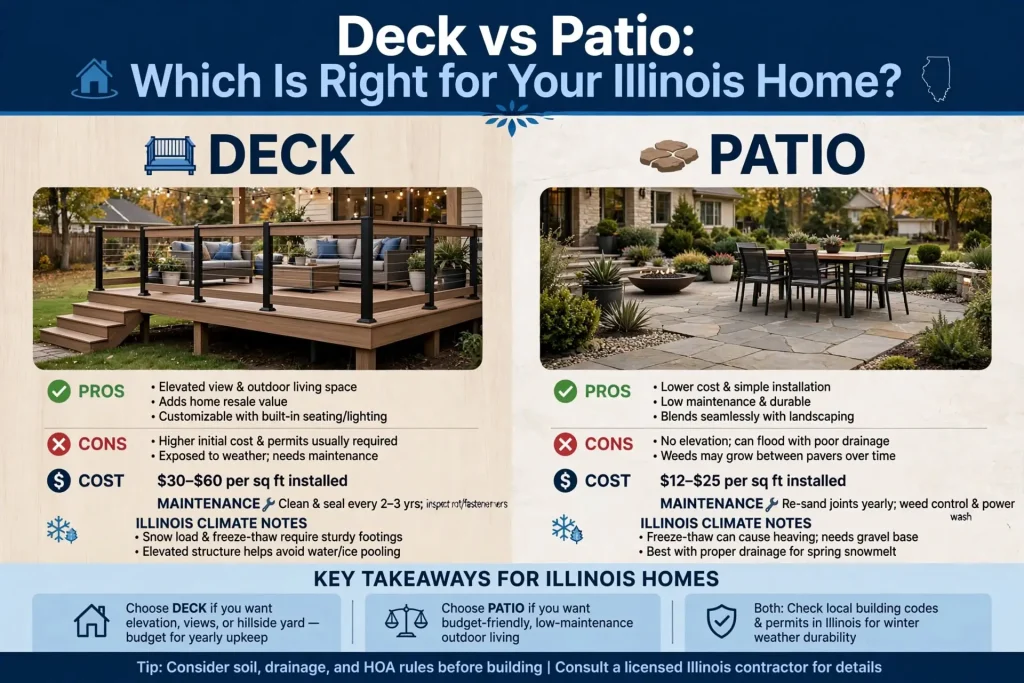
How Illinois Weather Changes the Deck vs Patio Decision
Central Illinois puts outdoor structures through serious seasonal stress every year. Winter freeze-thaw cycles expand and contract materials. Spring brings heavy rain and saturated clay soil that shifts and settles. Summer adds heat, humidity, and UV exposure.A deck sits elevated on footings that run below the frost line, largely isolating the walking surface from ground movement — a real advantage in our soil. A patio sits directly on the ground, which makes the base preparation underneath it the single most important part of the job. On Tazewell County’s clay-heavy soil, a poorly prepared patio base will heave and crack within a few seasons; a properly prepared one will last for decades.The takeaway: in Illinois, the deck vs patio question is less about which structure is “better” and more about which one, built correctly for our conditions, fits your yard and budget.Deck vs Patio: Cost Comparison
Decks cost more upfront. The structure requires footings, framing lumber, hardware, railings, and stairs on top of the decking surface itself. Pressure-treated lumber is the most affordable option, cedar sits in the middle, and composite decking is the premium surface. A standard deck of 200 to 400 square feet typically takes one to two weeks to build, not including permitting time.Patios are generally the more budget-friendly choice. Poured concrete is the most affordable patio material, concrete pavers sit in the mid-range, and natural stone is the premium option. With no elevated structure to build, labor and material costs run lower — a similar-sized patio generally takes three to seven days.One factor homeowners miss: site conditions. A sloped yard or poor drainage can narrow the cost gap fast. A deck on a steep slope may actually cost less than the extensive grading and retaining work a patio would need on the same site. That is why an on-site assessment matters more than any online cost calculator.Maintenance: What Each One Demands
This is where the decision gets personal, because it comes down to the upkeep you are willing to do.Wood decks demand the most. Pressure-treated decking needs regular sealing or staining, and without it boards check, warp, and splinter. Cedar resists moisture and insects better but still needs ongoing care.Composite decks changed the equation. Modern composite boards resist fading, staining, mold, cracking, and splintering — and never need sealing, staining, or painting. In central Illinois, composite delivers long-term performance that natural wood cannot match without consistent upkeep. Maintenance is essentially periodic cleaning with soap and water.Patios are low-maintenance across the board, with one caveat. Concrete pavers handle expansion and contraction without cracking, and individual pavers can be lifted and reset if settling occurs. Natural stone holds up extremely well on an adequate base. Poured concrete is the outlier: it tends to crack over time in Illinois freeze-thaw conditions. Occasional sweeping and rinsing is typically all a patio needs.If low maintenance is the priority, the ranking is simple: composite deck or paver patio at the top, natural wood deck at the bottom.Lifespan and Durability in Illinois Conditions
- Composite deck: 30+ years with minimal maintenance. Handles freeze-thaw, summer heat, and moisture without the warping and cracking that age natural wood.
- Pressure-treated wood deck: 15 to 25 years with proper, consistent upkeep. Skip the maintenance and that number drops fast.
- Paver patio: can last indefinitely on an adequate base — individual pavers reset without a full replacement.
- Natural stone patio: extremely long-lived with proper installation.
- Poured concrete patio: typically cracks within 10 to 20 years from freeze-thaw stress, which is why many central Illinois homeowners prefer pavers.
Design, Privacy, and How You Will Use the Space
Decks suit sloped yards, main-floor-level entertaining, and defined zones — dining up top, lounge seating below, pergolas, and integrated lighting. A deck reads as an architectural extension of the house.Patios excel at ground level. They connect to the landscaping, work beautifully around fire pits and outdoor kitchens, and handle heavy furniture and grills without structural concern. Pavers can curve and flow through the yard in ways a rectangular deck cannot.Also consider sun and privacy. An elevated deck catches breezes and views but may put you eye-to-eye with neighbors; a ground-level patio tucked into landscaping can feel more private. Walk your yard at different times of day before deciding.Permits in Pekin, IL
A practical detail that surprises homeowners: the City of Pekin generally requires a building permit for decks attached to the home or exceeding certain height and square footage thresholds. Patios at grade level typically face fewer requirements, though drainage and setback rules can still apply. Either way, permit applications, plan submissions, and inspection coordination should be part of your contractor’s scope — not paperwork on your kitchen table.Resale Value in Central Illinois
Both options add value and are consistently sought after by local buyers. Midwest industry data generally shows deck additions returning 60 to 75 percent of project cost in added home value. But build for how you live first and let the value follow — a composite deck your family uses every evening from May through October is worth more than any percentage, and buyers can tell when a space was built with care.So, Deck or Patio? A Simple Way to Decide
Choose a deck if your yard slopes, you want the space level with your main floor, you like defined entertaining zones, or you want the lowest-maintenance option in composite.Choose a patio if your yard is flat, you want the space to blend into the landscaping, you are working with a tighter budget, or you love the look of pavers or natural stone.Still torn? Most homeowners are until they see a design drawn on their actual property. An on-site consultation answers what no article can: how the grading works, where the sun falls, what the soil is doing, and which option gives you the most usable space for your budget.Frequently Asked Questions
Do I need a permit to build a deck in Pekin, IL?
In most cases, yes. The City of Pekin requires a building permit for decks attached to the home or exceeding certain height and square footage thresholds. Your contractor should handle the full permitting process, including plan submission and inspection coordination.What is the best decking material for Illinois weather?
Composite decking performs best in central Illinois over the long term — it handles freeze-thaw cycles, summer heat, and moisture without the warping, cracking, and maintenance demands of natural wood. Cedar is the better natural-wood choice over pressure-treated, but it still needs consistent upkeep.How long does it take to build a deck or patio?
A standard 200–400 sq ft deck typically takes one to two weeks from the start of construction, excluding permitting. A similar-sized patio generally takes three to seven days depending on material and site conditions.Will a deck or patio increase my home’s value?
In most cases, yes. Outdoor living spaces are consistently valued by central Illinois buyers, and Midwest data shows decks returning roughly 60–75% of project cost at resale — with the rest paid back in daily enjoyment while you live there.Ready to Build the Outdoor Space Your Backyard Has Been Missing?
The deck vs patio decision comes down to your yard, your budget, and how your family lives outdoors — and the fastest route to an answer is a professional walking your property with you. Grace Built Construction designs and builds decks and patios across Pekin, East Peoria, Morton, Washington, and surrounding Tazewell County, with honest planning, materials chosen for Illinois weather, and outdoor structures built to last.Call (309) 241-9593, email gracebuilt329@gmail.com, or request your free estimate online. We will walk your property, work through a design that fits your space and goals, and give you a clear plan for an outdoor space your family will actually use.Built on Integrity. Crafted to Last.Related reading: Top Deck Design Ideas for Illinois Backyards | Remodeling Permit Requirements in Pekin IL