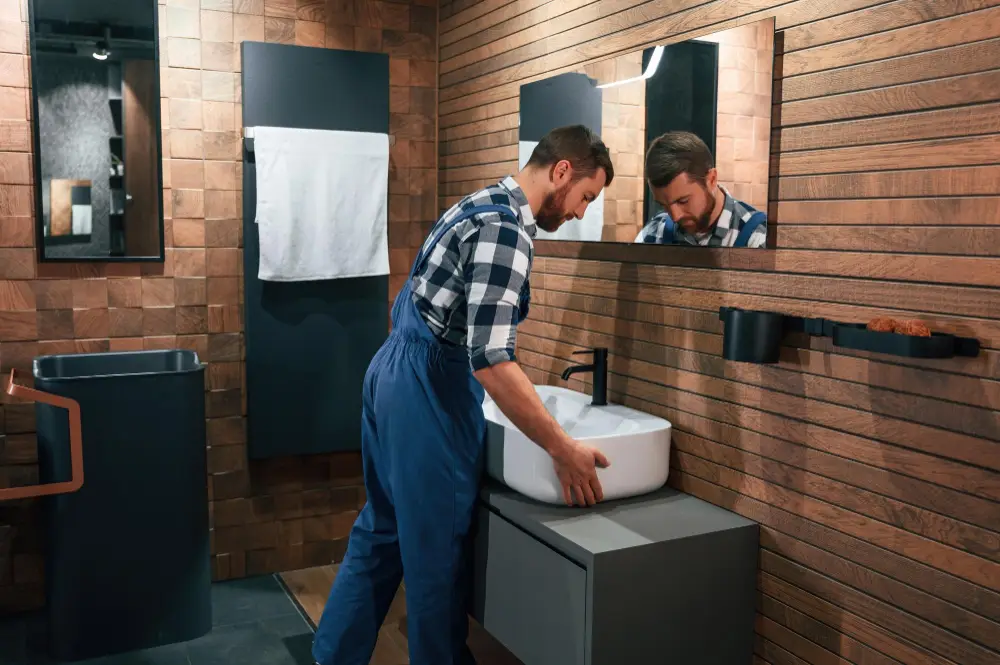
A finished basement without a bathroom is a room with an asterisk. The family movie night, the guest suite, the teenager’s hangout, and the home office all send their occupants up the stairs every time nature calls, and that asterisk is why the basement bathroom leads the list of most-requested basement upgrades. The basement bathroom addition cost question comes up in nearly every basement finishing conversation, and the honest answer spans a range: most projects in the Central Illinois market land between $12,000 and $30,000, with the spread driven almost entirely by one factor, plumbing, and specifically how far the new fixtures sit from the home’s existing drain lines and how deep those lines run. This guide breaks down where the money goes, the below-grade plumbing realities that make basement bathrooms their own category, the decisions that move the price, and the planning tips that keep the project on budget.
The Problem: Gravity Works Against Basement Bathrooms
Every bathroom in the house drains downhill to the main sewer line, and upstairs bathrooms get that slope for free. A basement bathroom sits at or below the level where the main line exits the house, which turns the simplest question in plumbing, where does the water go, into the project’s defining challenge.
Two answers exist. When the main sewer line runs deep enough beneath the slab, the new bathroom can drain by gravity like every other room, which requires breaking open the concrete floor to trench drain lines to the connection. When the line sits too shallow, or the trenching math gets ugly, an up-flush system or sewage ejector pit collects the bathroom’s waste and pumps it up to the main line. Both approaches work reliably when built correctly, both carry different costs and quirks, and knowing which one your basement needs is the first real step of budgeting. It is also why basement bathroom estimates vary so widely between houses that look identical from the street.
Where the Money Goes: The Cost Anatomy
A basement bathroom budget splits into layers, and seeing them separately explains the range.
Rough Plumbing: The Big Variable
Breaking the slab, trenching drains, running supply lines, and venting typically runs $3,000 to $8,000 when gravity drainage works and the fixtures sit near existing lines. A sewage ejector system adds $2,500 to $5,000 installed when pumping is required. The single best cost lever in the whole project lives here: placing the new bathroom close to existing plumbing, ideally beneath or beside an upstairs bathroom or the kitchen, shortens every run and can save thousands.
The Build-Out
Framing, insulation, moisture-appropriate drywall, electrical with the code-required GFCI circuits, ventilation fan ducted outdoors, and a door bring the room from trenches to walls, typically $3,000 to $6,000.
Fixtures & Finishes
The half-bath version, toilet and vanity, finishes for $2,000 to $5,000 in fixtures and surfaces. The full bath adds a shower, and the choice between an acrylic unit and custom tile swings this layer from $4,000 to $12,000. Flooring, lighting, mirror, and hardware complete it.
Half Bath or Full Bath: The Fork in the Budget
The half bath serves the movie room and the office at the lowest cost, typically $12,000 to $18,000 all-in, and it satisfies the most common basement need, which is simply ending the stair climb.
The full bath, typically $18,000 to $30,000, changes what the basement can be. With a shower in place, the basement bedroom becomes a legal, functional guest suite, the teenager’s zone becomes semi-independent, and the future in-law scenario becomes possible. The resale calculus favors it too, since a basement with a full bath counts differently in listings and appraisals than one without. Households planning an egress window and bedroom alongside should almost always choose the full bath, since the marginal cost buys a category change.
The Below-Grade Details That Protect the Investment
Basement bathrooms live in the dampest room of the house, and the build has to respect that. Ventilation is not optional: the exhaust fan must duct to the outdoors, not into a joist bay, and a humidity-sensing switch protects the room from the forgetfulness of guests. Materials follow basement rules, with mold-resistant drywall, tile or luxury vinyl underfoot, and no carpet anywhere near the wet zone.
The ejector pit, when the project needs one, deserves its own respect: a sealed, vented basin with a quality pump, ideally with an alarm, since this one appliance handles everything the bathroom produces. And every basement bathroom project should start with the moisture check the basement itself deserves, because tiling over a slab that seeps is the same mistake as finishing over one. Permits cover all of it, plumbing, electrical, and framing inspections included, and this is a project where the inspections genuinely protect the homeowner.
What Basement Bathrooms Cost in Central Illinois
The table below reflects local market pricing for the common project shapes.
| Project Configuration | Typical Cost Range | Notes |
| Half bath, near existing plumbing | $12,000 to $18,000 | Gravity drainage, short runs |
| Half bath, ejector system required | $15,000 to $21,000 | Adds pit and pump |
| Full bath, acrylic shower, near plumbing | $18,000 to $25,000 | The most common build |
| Full bath, custom tile shower | $24,000 to $32,000 | Design-forward finish level |
| Full bath, far from existing lines | Add $2,000 to $5,000 | Trenching and run length |
| Within a full basement finishing project | Save 10 to 20 percent | Trades already mobilized |
| Rough-in only (future bathroom) | $4,000 to $8,000 | Smart move during any finishing |
Two rows deserve highlighting. Building the bathroom inside a larger basement finishing project saves meaningfully, since the trades, permits, and dumpster are already on site. And the rough-in-only line is the sleeper strategy: homeowners finishing a basement without a bathroom budget today can trench and cap the plumbing now, while the slab is already open, preserving a cheap path to the bathroom later.
Frequently Asked Questions
How much does it cost to add a bathroom to a basement?
In the Central Illinois market, half baths typically run $12,000 to $18,000 and full baths $18,000 to $30,000, with plumbing distance and shower finish level driving the spread. Building the bathroom during a full basement finishing project trims 10 to 20 percent from the standalone price.
Do basement bathrooms need a special pump?
Only when the main sewer line sits too shallow for gravity drainage. In that case a sewage ejector pit or up-flush system pumps waste up to the main line, adding $2,500 to $5,000. A plumbing evaluation during the estimate determines which drainage path your basement gets.
Is it worth adding a full bath instead of a half bath in a basement?
When the basement includes or will include a bedroom, yes. The full bath turns the space into a true guest or in-law suite, counts differently at resale, and the marginal cost over a half bath buys a category change. Basements serving only as rec rooms do fine with a half bath.
Can you add a basement bathroom after the basement is finished?
Yes, but at a premium, since finished flooring and walls come up to reach the slab and studs. The smart hedge is a plumbing rough-in during the original finishing, trenching and capping the lines for $4,000 to $8,000, which preserves a low-cost path to the future bathroom.
Do you need a permit for a basement bathroom?
Yes, covering plumbing, electrical, and framing, with inspections at rough-in and completion. Basement bathrooms involve breaking the slab, new drain connections, and GFCI-protected circuits, all of which inspectors verify, and unpermitted plumbing is a resale problem waiting to surface.
Related Reading & Services
End the Stair Climb for Good
A basement bathroom is the upgrade that lets the finished basement finally act like part of the house, and the budget behaves once the plumbing question gets answered early. If you are planning a basement bathroom, or a full basement finish that ought to include one, in Pekin, East Peoria, Morton, Washington, or the surrounding Central Illinois area, our team evaluates the drainage path on the first visit and prices the project honestly from there. Request your free estimate or call (309) 241-9593 to find out what your basement can hold.
Related reading: Why Pekin Homes Need Basement Waterproofing Before Renovation | Common Basement Renovation Mistakes to Avoid